Step 1: The Business Case for Managed Care Plans
Sustained IPV programming requires executive sponsorship and an organizational commitment that goes beyond a single department. Incorporating training and intervention strategies for survivors of IPV can benefit the Managed Care Plan in myriad ways, including through alignment of policy and regulatory priorities; and quality, outcome, and financial measures. This section provides the messaging, return on investment framework, and readiness tools to build that commitment.
Case Study: MCP Leaders Share How they Embedded IPV in their Business Strategy
Molina Health Plan: Molina originally joined the CoP to address IPV training for case managers, which was driven by real-world cases and previous unsuccessful attempts by the case management team to secure funding for training due to timing and priorities. While they initially considered a focused pilot with one obstetrics provider, they ultimately engaged doulas, pediatrics, and case management teams to widen their reach and link to priority MCAS measures (PPC, WCVs). The team developed scripts and IPV coding guidance to embed their strategy into daily operations. The team noted this initiative aligns with broader population health management goals from DHCS, with strong leadership buy-in for the long-term population health benefits and alignment with state priorities.
PopHealth Learning Center, IPV Community of Practice, 2026
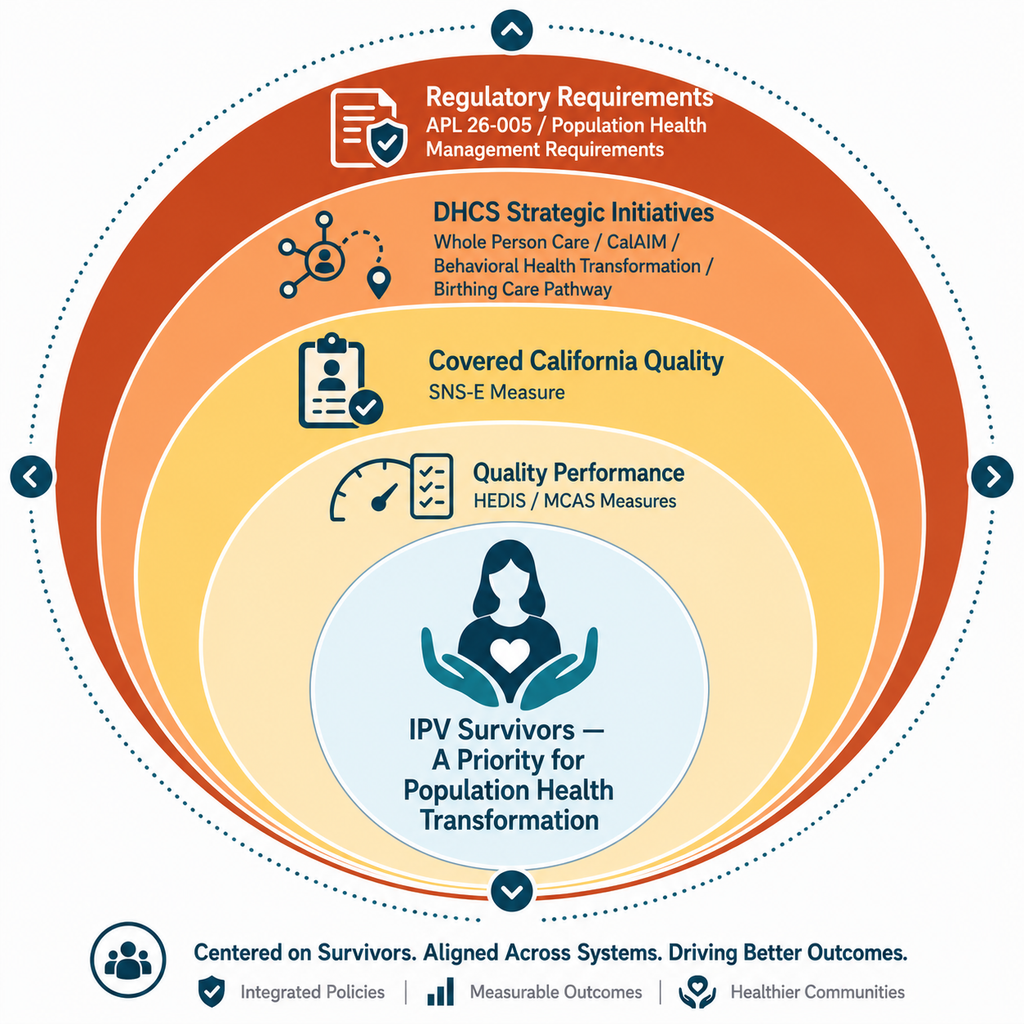
- Alignment with DHCS priorities: Maternal and child health / Birthing Care Pathway(opens in new tab), health equity roadmap(opens in new tab), whole-person(opens in new tab) care, Behavioral Health Transformation(opens in new tab), transitional care policies, and CalAIM
- Connection to regulatory requirements: DHCS has included work to incorporate prevention and response to IPV into regulatory elements designed to help assess and treat the broader Medi-Cal population. These requirements support tools and services that educate, screen, treat, and support survivors: PHM requirements(opens in new tab), All Plan Letters, including Maternity Care for Pregnant and Postpartum Medi-Cal Members (APL 26-005)(opens in new tab)
- Quality performance: HEDIS-Like and MCAS Crosswalk opportunities; IPV screening embedded in existing measure touchpoints opportunities; IPV screening embedded in existing measure touchpoints
- Population health outcomes: Supporting high-risk individuals with the right care at the right time; reducing preventable complications using whole-person care approaches
- Training and service delivery mandates: For example, Community Health Worker(opens in new tab) violence prevention services and core training requirements
Financial Implications
- IPV is associated with higher ED utilization, inpatient admissions, inconsistent or lack of prenatal visits, poor perinatal outcomes, and chronic disease, all of which are high-cost categories for MCPs.1
- Effective IPV education, screening, and response can reduce downstream utilization and improve care engagement.
- MCPs face the risk of noncompliance if they fail to meet DHCS PHM and APL requirements.
- IPV-related metrics can be embedded in value-based payment and incentive arrangements.
Implementing an IPV education and intervention plan across the MCP, provider networks, and other ancillary entities requires time and effort, both scarce resources. Integrating IPV education in standard managed care activities and approaches is one strategy that can help mitigate the costs. For example:
- Education will be required for internal staff and provider networks and can be added to existing training requirements. The type of education and level of training should be tailored based on staff role and type of IPV-associated work (i.e., member facing roles versus data analysis).
- Intervention design and integration should align with both strategic and regulatory initiatives and can take place in conjunction with education and training. Member-facing MCP staff and provider networks should be knowledgeable about existing resources, Medi-Cal services and benefits, and strategies to support IPV survivors.
- Integrate IPV-informed care expectations into existing provider oversight infrastructure, including credentialing, facility site reviews, medical record reviews, and network monitoring. Rather than creating a separate monitoring process, MCPs can incorporate assessment of IPV education, screening, documentation, referral pathways, and interventions into existing quality and provider oversight activities.
Implementation Tip: Messaging for the Board
Lead with outcomes and equity, not just compliance. Frame IPV programming as a population health investment that reduces preventable harm, improves quality scores, and demonstrates your plan’s commitment to whole-person care for the most vulnerable members.
Survivor Voice: Focus on Whole-Person Care
When you talk about value-based care and whole-person care, you can always provide the resources and have the conversation. But we still need support and [to] make sure that you’re establishing relationships with organizations within your community, so that patients and members are getting that continuous level of support. Because when you’re looking at comorbidity, if you’re someone who constantly has your cortisol on 20, that’s going to have some health implications. There are going to be things that show physical manifestations. Taking the approach of being constantly informed, putting some measures in place to really provide that safe space, but then also get individuals connected to the right resources, is super important.
- Steele-Baser M, Brown AL, D’Angelo DV, et al. Intimate Partner Violence and Pregnancy and Infant Health Outcomes — Pregnancy Risk Assessment Monitoring System, Nine U.S. Jurisdictions, 2016–2022. MMWR Morb Mortal Wkly Rep 2024;73:1093–1098. DOI: http://dx.doi.org/10.15585/mmwr.mm7348a1 ↩︎