Quality Improvement (QI) Cycle Structure
From Improvement to Sustainability
Improvement is iterative. Start with small tests, use data and feedback to learn, and scale changes only after demonstrating that they work in the local context.

Build the Evaluation Foundation
- Confirm aim statement that is specific, measurable, time-bound (e.g., “By December 2027, 80% of contracted perinatal providers will deliver CUES-based universal education at the initial prenatal visit”).
- Establish baseline performance for each measure prior to intervention rollout.
- Set performance and equity targets aligned with relevant MCAS measures, Birthing Care Pathway priorities, and internal goals.
- Stratify all measures by race/ethnicity, language, age, geography, and special population (e.g., perinatal, pediatric, adolescent, unhoused, behavioral health) to surface disparities.
- Identify data sources and owners for each measure (e.g., claims, encounter data, provider attestation, CBO referral data, member experience surveys).
Apply the Model for Improvement
Use the three foundational questions to guide every improvement cycle:
- What are we trying to accomplish? (Aim)
- How will we know that a change is an improvement? (Measures)
- What changes can we test that will result in improvement? (Change ideas)
Test changes through Plan-Do-Study-Act (PDSA) cycles. Start with a small test, learn from the results, adapt as needed, and scale and spread successful changes over time:1
- Plan: Define the test, predict results, identify who/what/when/where.
- Do: Run the test on a small scale (one clinic, one care manager, one workflow).
- Study: Compare results to predictions; identify what was learned.
- Act: Adopt, adapt, or abandon based on findings; plan the next cycle.
PDSA in Practice: Testing CUES in Care Management
- Aim: Increase reliable delivery and documentation of CUES-based universal education during eligible care management encounters.
- Cycle 1: One care manager tests the CUES workflow with five eligible members. Staff find that the education fits into the encounter, but documentation is cumbersome.
- Cycle 2: Three care managers test a simplified documentation process. Documentation improves, but staff identify a need for a quick-reference script.
- Cycle 3: The team adds a job aid and tests the revised workflow across the care management team. Results and staff feedback are reviewed before deciding whether to expand the approach.
- Key lesson: PDSA cycles are designed for learning. A test that does not work as predicted still provides useful information for the next cycle.
Recommended measure categories
Maintain a balanced measure set across the categories below. Detailed measure specifications, numerator/denominator logic, and data source guidance are available in the IPV Measures Framework. Select a small set of measures that can be reviewed consistently over time. More measures do not necessarily create better insight; prioritize measures that help the team determine whether implementation is occurring as intended and whether changes are improving care.
- Structural measures: Policy adoption, provider training completion, CBO contract status, EHR/coding readiness
- Process measures: Rate of universal education delivery, screening completion (where applicable), warm handoff completion, closed-loop referral rate, EOB suppression utilization
- Outcome measures: Member-reported safety and resource awareness, perinatal outcomes (e.g., preterm birth, postpartum depression screening), ED utilization, behavioral health engagement
- Balancing measures: Provider burden, visit time impact, member trust and satisfaction, unintended disclosure or safety events
- Equity measures: Disparity ratios across stratified subpopulations for each process and outcome measure
Example: Tracking Universal Education Over Time
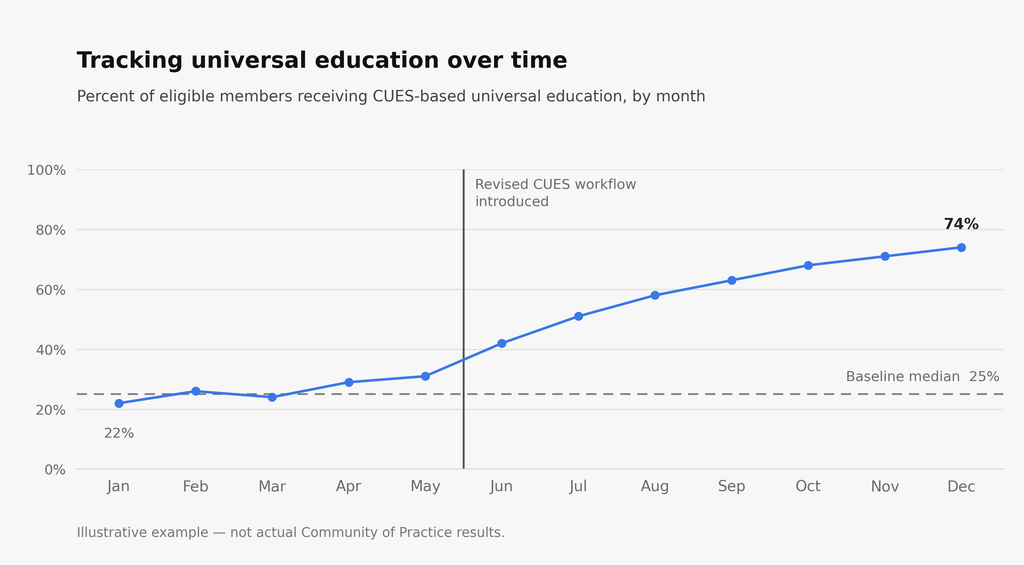
Plotting performance over time helps teams understand whether changes are associated with sustained improvement rather than reacting to individual data points. (not actual CoP results)
Establish cadence and governance
- Quarterly performance reviews with the cross-functional team (see RASCI matrix)
- Annual evaluation report shared with executive sponsor, board, and DHCS as appropriate
- Monthly operational dashboards for program leads to monitor implementation and identify emerging issues
- Standing QI workgroup to prioritize PDSA cycles, review run charts, and escalate barriers
- Feedback loops with provider network and CBO partners to validate data and surface field insights
Use data to drive action
- Display key measures over time using run charts so teams can identify shifts, trends, and other patterns in performance. Teams with more advanced QI analytic capacity may also use control charts.
- Avoid reacting to single data points; look for shifts, trends, and patterns over time.
- Pair quantitative data with qualitative input (e.g., member listening sessions, provider focus groups, CBO partner feedback).
Communicate findings transparently: what is working, what is not, and what will be tested next.
Considerations for IPV-specific evaluation
- Privacy and safety must be foundational: Measure design should never compromise survivor confidentiality (see Privacy Principles & EOB Considerations).
- Disclosure rates are not the goal; education reach and resource awareness are stronger leading indicators.
- Some outcomes (e.g., reduction in reproductive coercion, increased relationship safety) require member-reported data and may need partnership with CBOs or evaluators.
- Recognize that improvement in IPV outcomes is long-horizon work; structural and process gains should be celebrated as meaningful progress.
Implementation Tip: Sustaining Beyond the Champion
Avoid dependence on a single champion. IPV initiatives are more likely to withstand staff turnover when responsibility is built into organizational structures and routine operations. Institutionalize the effort by embedding IPV in QI committee standing agendas; including it in provider contracts; and building it into the LMS curriculum. If the champion leaves, the program should continue.
Quality Improvement Resources
- IPV PDSA Template and Tracker
- IPV Measures Framework
- Institute for Healthcare Improvement: Model for Improvement(opens in new tab)
- Institute for Healthcare Improvement: Testing Changes Using PDSA Cycles(opens in new tab)
- Institute for Healthcare Improvement: Run Chart Tool(opens in new tab)
- Institute for Healthcare Improvement: Quality Improvement Project Measures Worksheet(opens in new tab)
- The Model for Improvement (three fundamental questions + Plan-Do-Study-Act cycles) was developed by Associates in Process Improvement and is used by the Institute for Healthcare Improvement (IHI) as its primary quality-improvement framework. See IHI, “Model for Improvement,” ihi.org/library/model-for-improvement. ↩︎